 Ford introduced EcoBoost technology in 2009 and has continued refining it ever since. What began with a twin-turbocharged 3.5L V6 soon expanded into the F-150, smaller four-cylinder and three-cylinder engines, and performance applications such as the Mustang EcoBoost and Ford Raptor.
Today, EcoBoost refers to a family of gasoline engines that combine turbocharging, direct fuel injection, and variable camshaft timing. Together, these technologies help Ford produce strong horsepower and torque from relatively compact engines across trucks, SUVs, and performance vehicles.
For shoppers, the important question isn’t really how complicated the technology is. It’s what EcoBoost can do for the way you drive. Depending on the Ford you choose, that can mean responsive acceleration for everyday commuting, useful towing capability, better maneuverability, or serious performance when you need it.
How Does Ford EcoBoost Work?
EcoBoost combines several technologies that help an engine make power efficiently without simply increasing its size.
Turbocharging uses energy from the engine’s exhaust to force more air into the engine. More air allows the engine to produce additional power when you ask for it, which can be especially noticeable when merging onto the freeway, passing, climbing a grade, or pulling a trailer.
Direct fuel injection precisely delivers fuel into the combustion chamber. That helps the engine manage fuel efficiently while still producing the power needed under acceleration.
Variable camshaft timing continuously changes valve timing based on driving conditions. The engine can respond one way when you’re accelerating and another when you’re cruising steadily down the highway.
You don’t need to think about any of this while you’re driving. The point is that EcoBoost technology allows a relatively compact engine to behave like a much larger one when extra power is needed.
What Are the Benefits of an EcoBoost Engine?
The exact experience varies considerably between a Bronco Sport and an F-150, but EcoBoost engines share several practical advantages:
• Strong low-end torque: Turbocharging helps provide useful pulling power without requiring the engine to constantly run at high rpm.
• Responsive acceleration: Extra power is readily available for merging, passing, climbing hills, and other everyday situations.
• More power from a smaller engine: EcoBoost allows Ford to deliver substantial horsepower and torque without relying exclusively on larger-displacement engines.
• Fuel-economy potential: Some EcoBoost applications provide a useful balance between performance and everyday fuel consumption.
• Wide-ranging capability: Ford uses EcoBoost engines in compact pickups, full-size trucks, two- and three-row SUVs, off-road vehicles, and the Mustang.
That range is one of EcoBoost’s biggest strengths. The technology isn’t tied to one particular type of Ford or one kind of driver.
EcoBoost Performance and Fuel Economy Examples
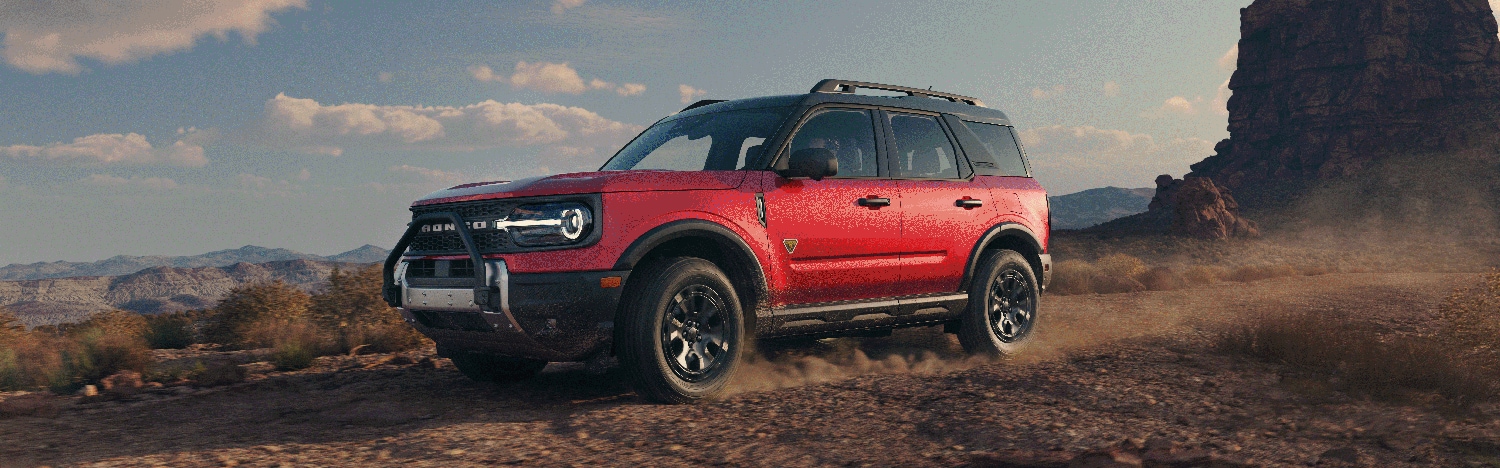
The 2026 Ford Bronco Sport shows how EcoBoost can work well in a compact SUV. Its standard 1.5L EcoBoost produces 180 horsepower and 200 lb.-ft of torque while carrying an EPA-estimated rating of 25 mpg city and 30 mpg highway. The available 2.0L EcoBoost increases output to 250 horsepower and 280 lb.-ft of torque.
At the performance end of the lineup, the 2026 Mustang EcoBoost uses a 2.3L engine producing 315 horsepower and 350 lb.-ft of torque when using 93-octane fuel. That gives shoppers Mustang performance without requiring a V8.
EcoBoost also scales into serious truck capability. The 2026 Ranger offers a 2.3L engine with 270 horsepower and 310 lb.-ft of torque, an available 2.7L with 315 horsepower and 400 lb.-ft, and a Ranger Raptor-exclusive 3.0L EcoBoost producing 405 horsepower and 430 lb.-ft. Properly configured Ranger models can tow up to 7,500 pounds.
The F-150 takes that capability even further. Its available 3.5L EcoBoost V6 produces up to 500 lb.-ft of torque and supports a maximum available tow rating of 13,500 pounds when properly configured. Ford also offers the 2.7L EcoBoost V6 and the F-150 Raptor’s High-Output 3.5L EcoBoost V6.
Which Current Ford Models Offer EcoBoost Engines?
Engine availability can depend on trim, drivetrain, configuration, and model year.
| Ford Model | EcoBoost Engine Option(s) |
| Bronco Sport | 1.5L EcoBoost, 2.0L EcoBoost |
| Bronco | 2.3L EcoBoost I-4, 2.7L EcoBoost V6, 3.0L EcoBoost V6 |
| Explorer | 2.3L EcoBoost I-4, 3.0L EcoBoost V6 |
| Expedition | 3.5L EcoBoost V6 |
| Maverick | Available 2.0L EcoBoost |
| Ranger | 2.3L EcoBoost, 2.7L EcoBoost V6, 3.0L EcoBoost V6 |
| F-150 | 2.7L EcoBoost V6, 3.5L EcoBoost V6, High-Output 3.5L EcoBoost V6 |
| Mustang | 2.3L EcoBoost |
Ford has released the 2027 Explorer lineup, which continues to offer the 2.3L EcoBoost I-4 and available 3.0L EcoBoost V6 on select models.
Which EcoBoost-Powered Ford Fits the Way You Drive?
Choosing between EcoBoost-powered Ford models gets easier when you start with what you’ll actually ask the vehicle to do.
| If You Prioritize... | Ford Models to Consider |
| Daily commuting and maneuverability | Bronco Sport, Maverick, Mustang EcoBoost |
| Compact pickup versatility | Maverick |
| Off-road driving and outdoor recreation | Bronco, Bronco Sport |
| Three-row family space | Explorer |
| Full-size SUV space and towing | Expedition |
| Midsize pickup capability | Ranger |
| Towing and full-size truck versatility | F-150 |
| Sporty performance | Mustang EcoBoost |
EcoBoost for Driving Around Colma and the San Francisco Peninsula
Serramonte Ford sits just off the I-280 corridor in Colma, placing local drivers near several very different kinds of Bay Area driving. I-280, Highway 1, Junipero Serra Boulevard, and routes connecting into San Francisco and the Peninsula can take you from dense traffic to faster freeway driving and coastal roads within the same trip. Serramonte Ford itself identifies I-280 as a primary connection for customers traveling from San Francisco, Daly City, San Bruno, and surrounding communities.
For daily trips around Colma, Daly City, and San Francisco, the smaller footprint of a Bronco Sport or Maverick can make crowded streets, parking, and frequent traffic changes easier to manage. When an opening finally appears on I-280, the turbocharged engine gives you useful power for merging or getting back up to freeway speed.
Heading toward Pacifica or down Highway 1 changes the equation. The Bronco Sport’s standard 4x4 and available 2.0L EcoBoost make sense for shoppers who want a compact everyday SUV but also spend weekends carrying outdoor gear or exploring beyond city streets. Highway 1 is a major regional connection between Daly City, Pacifica, and coastal destinations.
Drivers who regularly carry more passengers may find the Explorer better suited to Peninsula family travel, while the Expedition adds significantly more space and towing capability for larger trailers or recreational equipment.
And if your weekends involve hauling bikes, building supplies, camping gear, or a trailer out of the Bay Area, the Maverick, Ranger, and F-150 provide three very different pickup sizes. You don’t necessarily need the biggest truck available; you need the truck whose size and EcoBoost capability match what you’re actually carrying or towing.
Does EcoBoost Require Premium Gas?
Not every EcoBoost engine requires premium fuel for normal driving. Fuel recommendations vary by vehicle and engine, and some published maximum horsepower or torque figures are achieved using premium fuel.
For example, Ford lists regular unleaded as the minimum fuel for both 2026 Bronco Sport EcoBoost engines, although premium is recommended for the 2.0L engine. Ford also notes that its published Bronco Sport horsepower and torque ratings are based on premium fuel.
Other performance-oriented applications may specifically recommend higher octane. The 2026 Ranger Raptor’s 3.0L EcoBoost, for example, calls for 91-octane fuel.
For the Ford you’re considering, check the Owner’s Manual or Ford’s fuel recommendation for that specific engine rather than assuming every EcoBoost has the same requirements.
Find the Right EcoBoost-Powered Ford at Serramonte Ford
EcoBoost technology gives Ford shoppers plenty of choices, from compact vehicles that work well for Peninsula commuting to trucks and SUVs built for towing, recreation, and longer trips.
The best choice comes down to how much passenger space, cargo room, performance, fuel economy, and capability you actually need. Browse the current new Ford inventory at Serramonte Ford, or visit us at 999 Serramonte Blvd., Colma, CA 94014. Our team can help you compare Ford models, trims, EcoBoost engines, towing capability, and features to find the combination that fits the way you drive.
Categories:
EcoBoost